
Twelve large companies in Switzerland. Not one can forecast its own product returns.
These companies run material loops every day, as long as the material never left the site. The moment something has to come back from outside the organisation, almost everything stops.

Deborah de Wolff
Co-founder & CEO, Liinka5 min read


We read the public reporting of twelve large companies with a significant presence in Switzerland and assessed their circular supply chain maturity using our AI tool. This article is the second in a series on circular maturity of companies. The gap we found is not what most people would expect.
It is not a lack of ambition, technology or supplier willingness.
It is that circularity stops at the company boundary.
Here is the tell. By-product circulation is now mainstream in this sample. A chemicals group buys steam from a neighboring energy from waste plant. An electronics manufacturer reclaims scrap metal and feeds re-compounded material back into production. These are not pilots. They are operating assets with a payback.
So these companies can run material loops. They do it every day.
However, they only do it when the material is already on site, already represents a disposal cost, and already belongs to them.
The moment a loop requires something to come back from outside the organization, almost everything stops.
Why the return journey is the hardest part
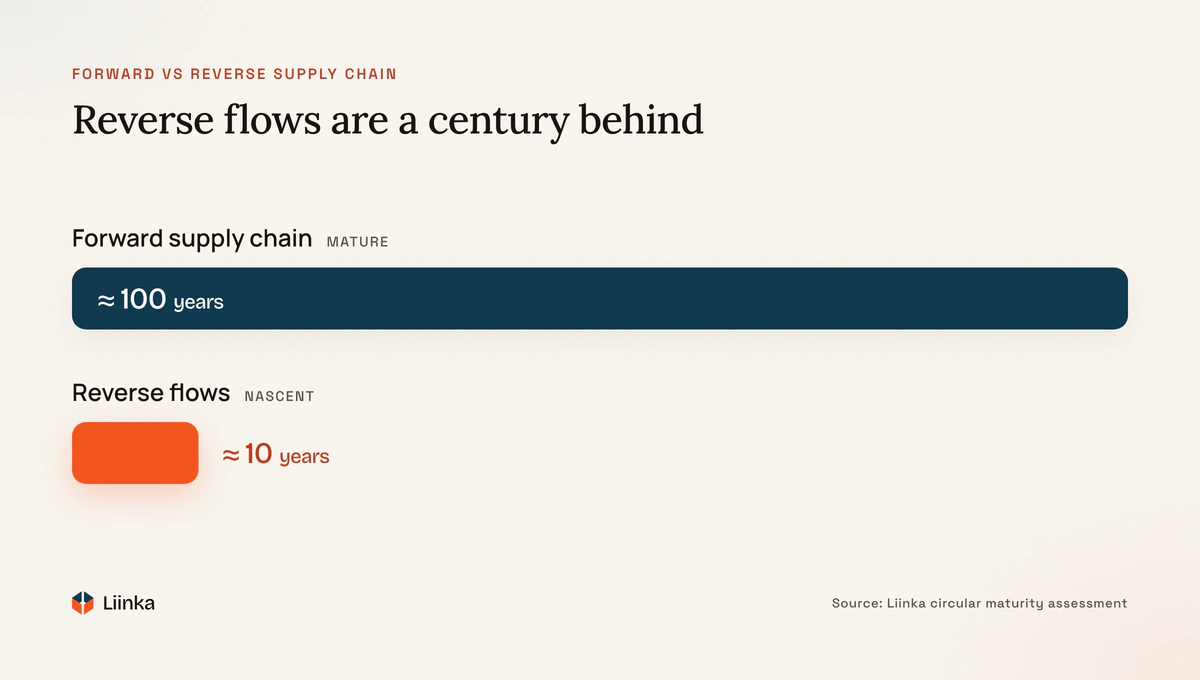
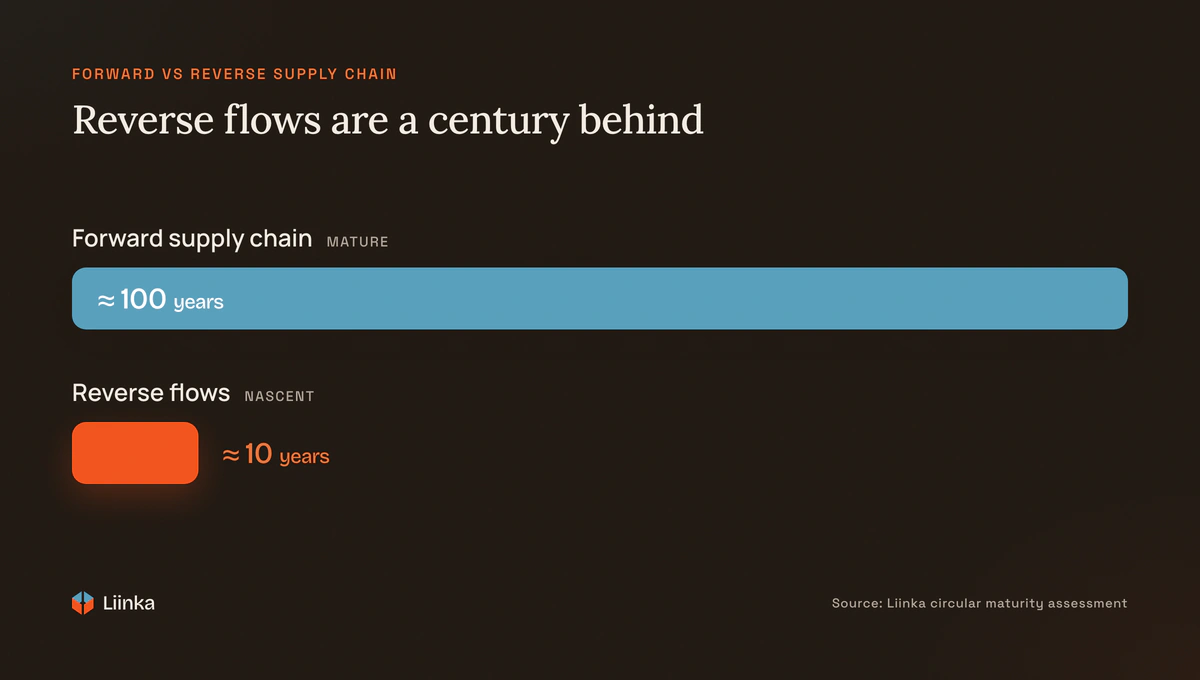
The forward supply chain has a century of investment, standards and talent behind it. Reverse flows have been around for roughly a decade, mostly as pilots.
This asymmetry hinders circular development.
Without return forecasts, you cannot justify collection infrastructure. Without infrastructure, the returns never materialize. Without returns, there is no data. Without data, the business case never clears the hurdle rate.
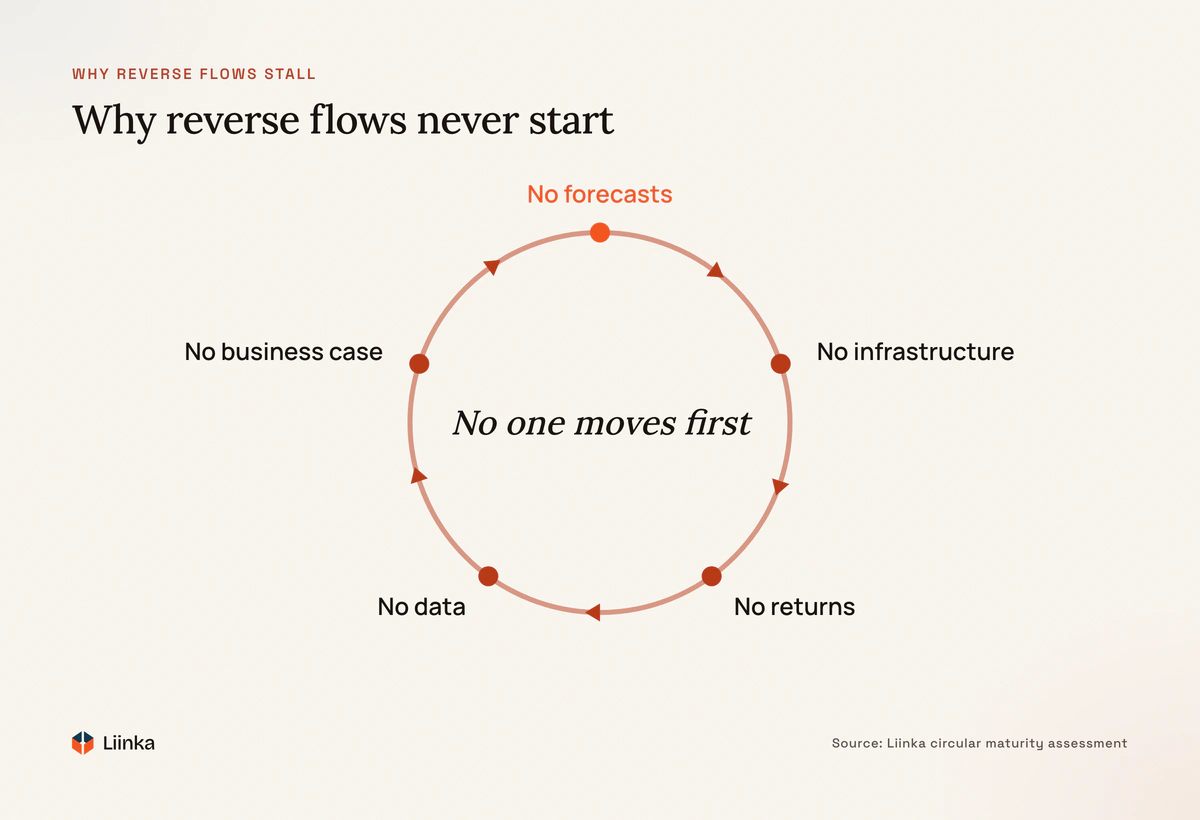
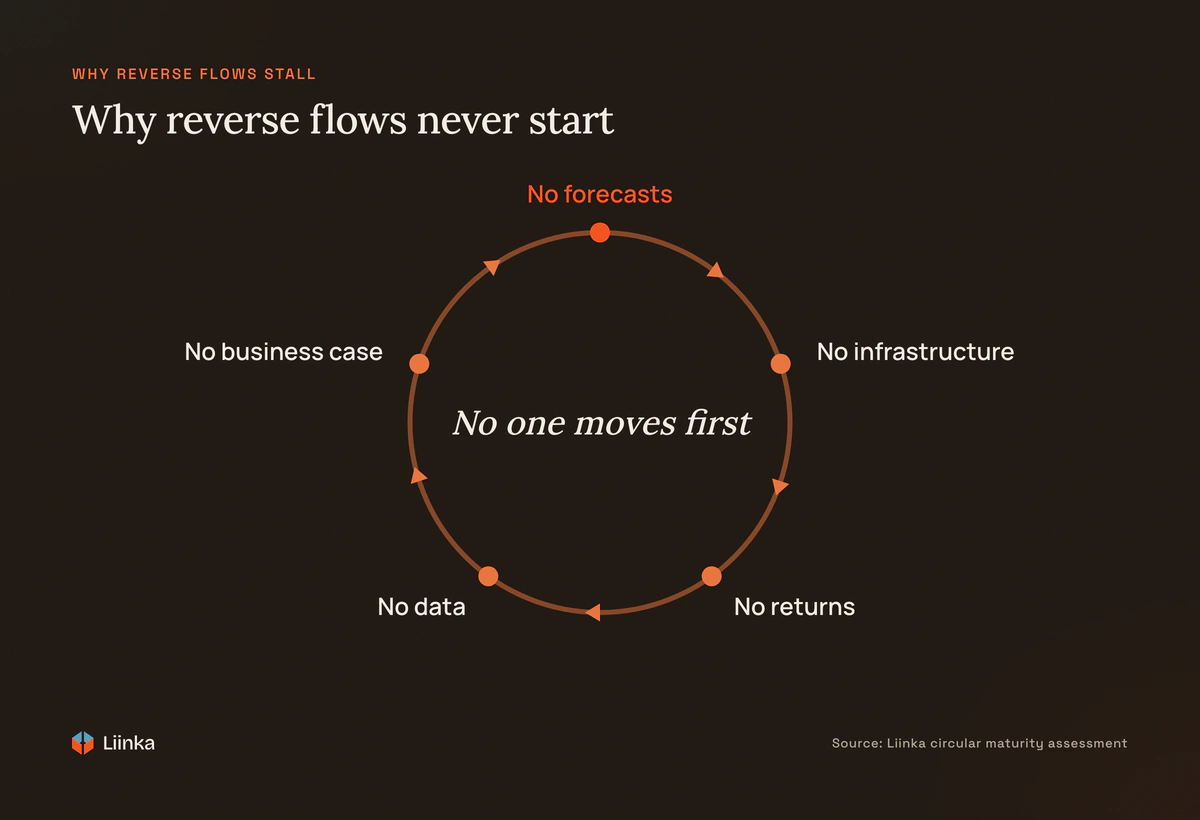
Companies are not failing at reverse logistics. They simply don’t kickstart the loop that would make it viable.
Someone has to move first, and the first move never survives a conventional payback calculation. Therein lies the actual problem, rather than in operations.
The weakest dimension is also the cheapest to fix
Governance came out lowest of all eight dimensions measured, due to one specific reason.
Not one company in the sample has restructured supply chain responsibilities for circularity. Neither do they link circularity to how supply chain teams are evaluated or rewarded.
Half of them do nonetheless train their supply chain teams on circularity.
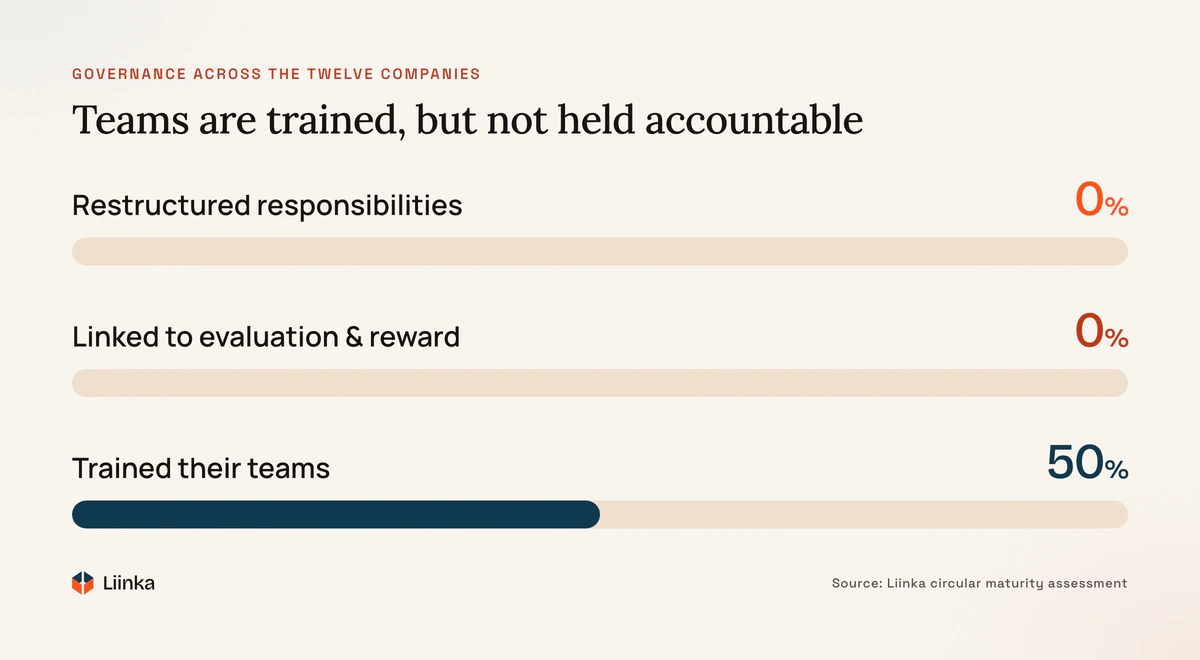
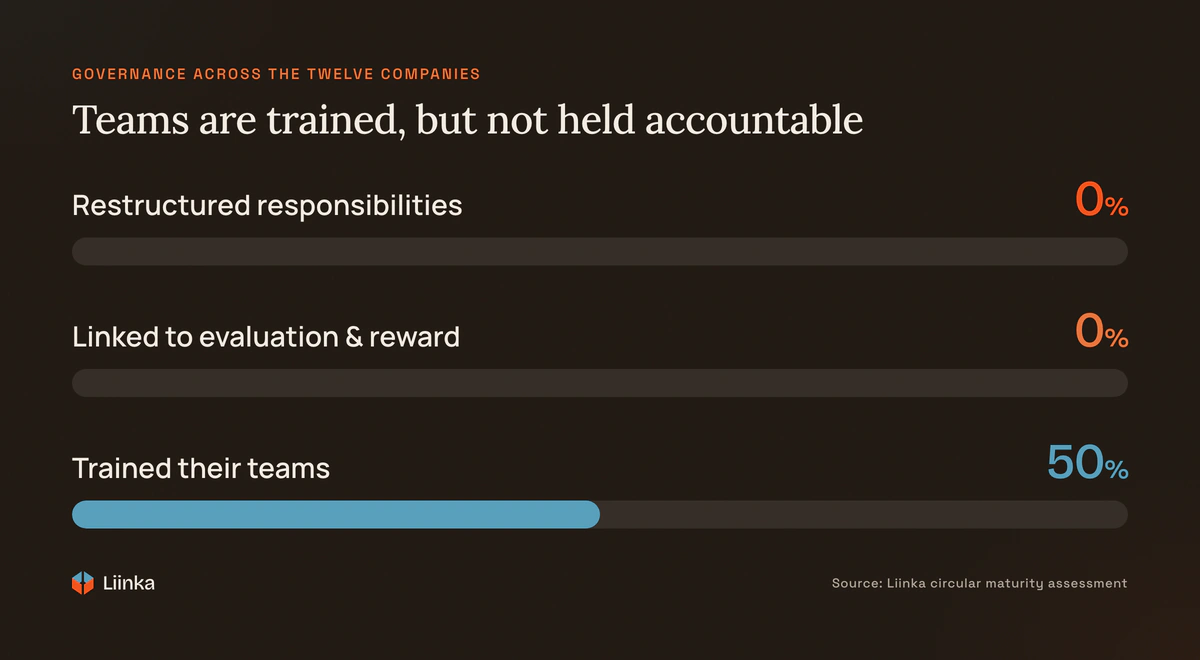
Think about what that means in practice: you tell a planner that circularity matters. Then you measure them on cost, service level and on-time-delivery, just as you did before. Reverse flows are slower, smaller, more variable and more expensive per unit than forward flows. Therefore, the planner will deprioritize circularity every single time.
So the knowledge is being distributed, whereas accountability isn’t.
Compliance visibility is not circular visibility
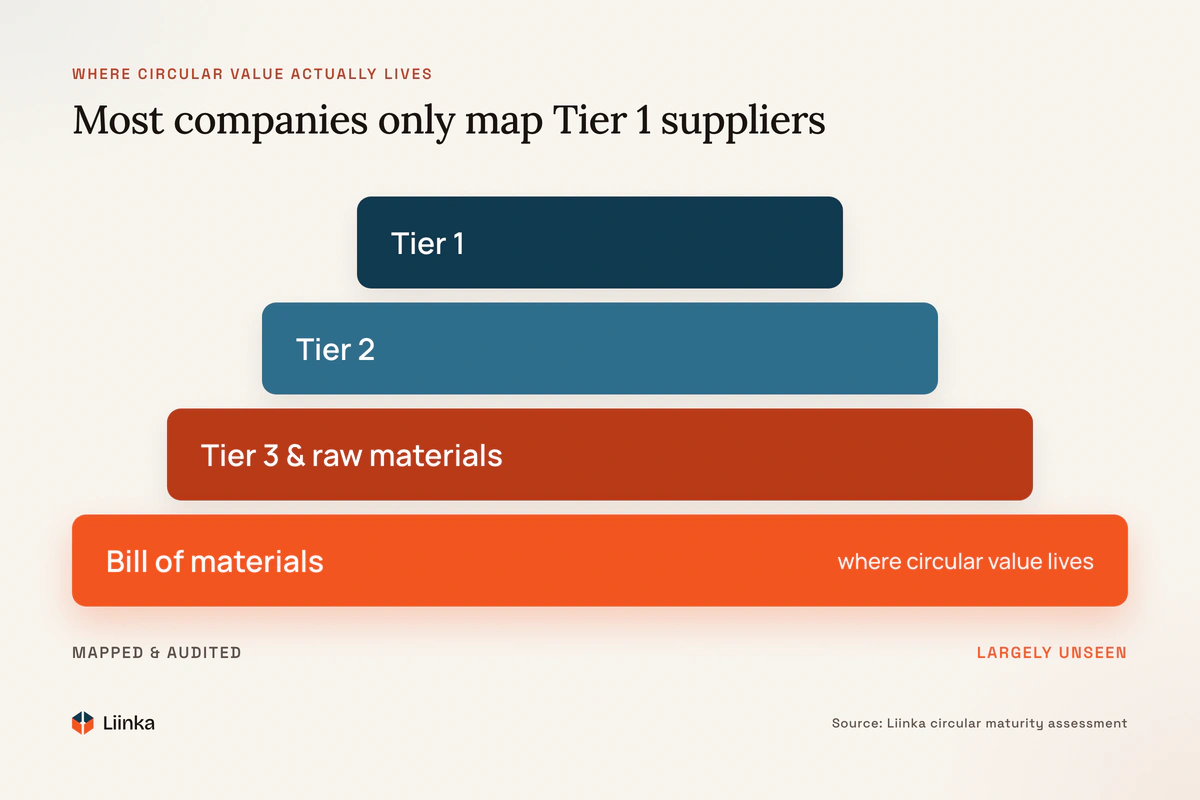
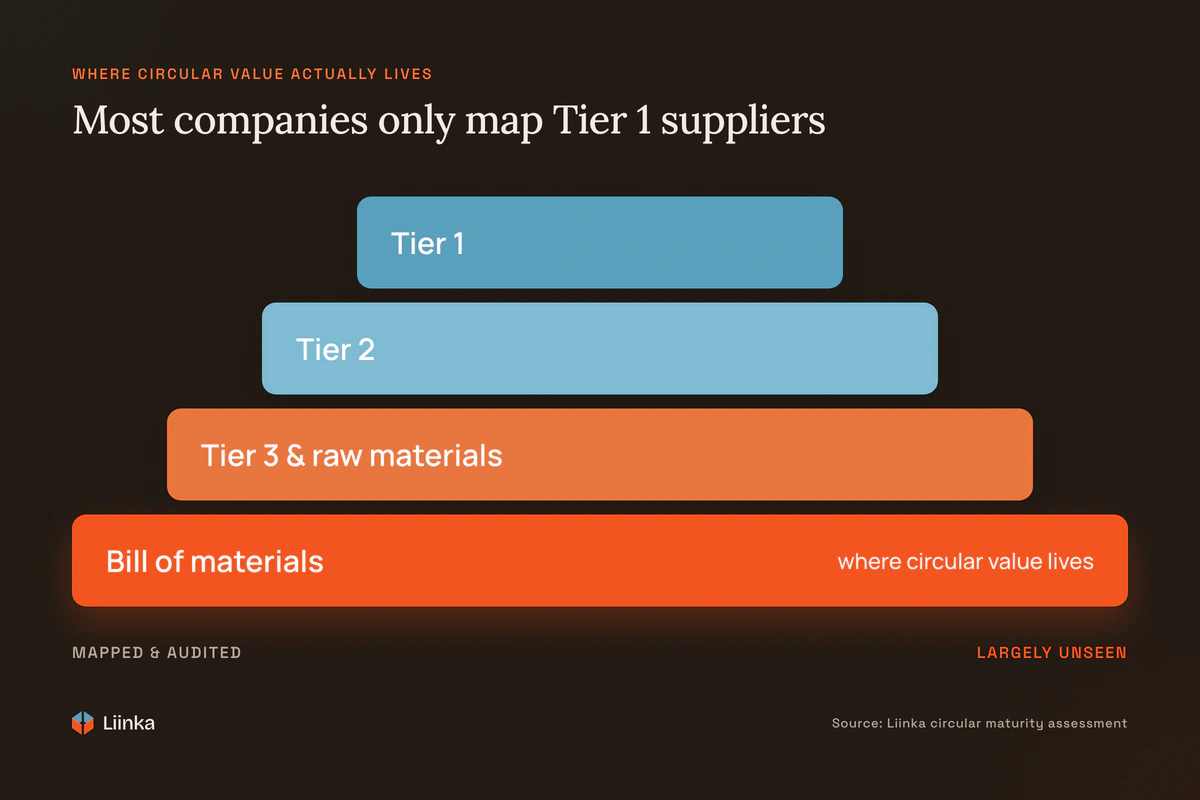
Most companies in the sample map their Tier 1 suppliers, but almost none go deeper.
This is not an oversight. Tier 1 analysis is exactly what audits, codes of conduct and supplier questionnaires are built to deliver. It is a compliance process, and it works as intended.
But circular value can rarely be found at Tier 1. The recycled content, the material substitution, the recoverable component and the contamination that ruin an entire stream are almost always further upstream.
The process offers enough visibility to be compliant, but nowhere near enough to become truly circular.
The same logic applies within the product. Very few companies can document what actually goes into the things they make. A company that cannot say what is in its own product cannot design recovery for it, cannot credibly certify recycled content, and will not be ready for the digital product passport requirements now creeping into regulation.
Technology is not the constraint. Half the sample already run AI, digital twins and advanced analytics in their supply chain. The capability is in-house. Nevertheless, it is almost exclusively orientated towards the forward flow, because that is where the KPIs are.
Which brings us back to governance.
Take-back is a marketing problem more than a logistics problem
Almost none of the companies in the sample use marketing to give customers a reason to return anything. They then treat weak return volumes as an operations failure.
Customers do not return products because a reverse logistics network exists. They return products when it is convenient, visible and worth something to them. That is a demand generation question, and it pertains to a different function entirely.
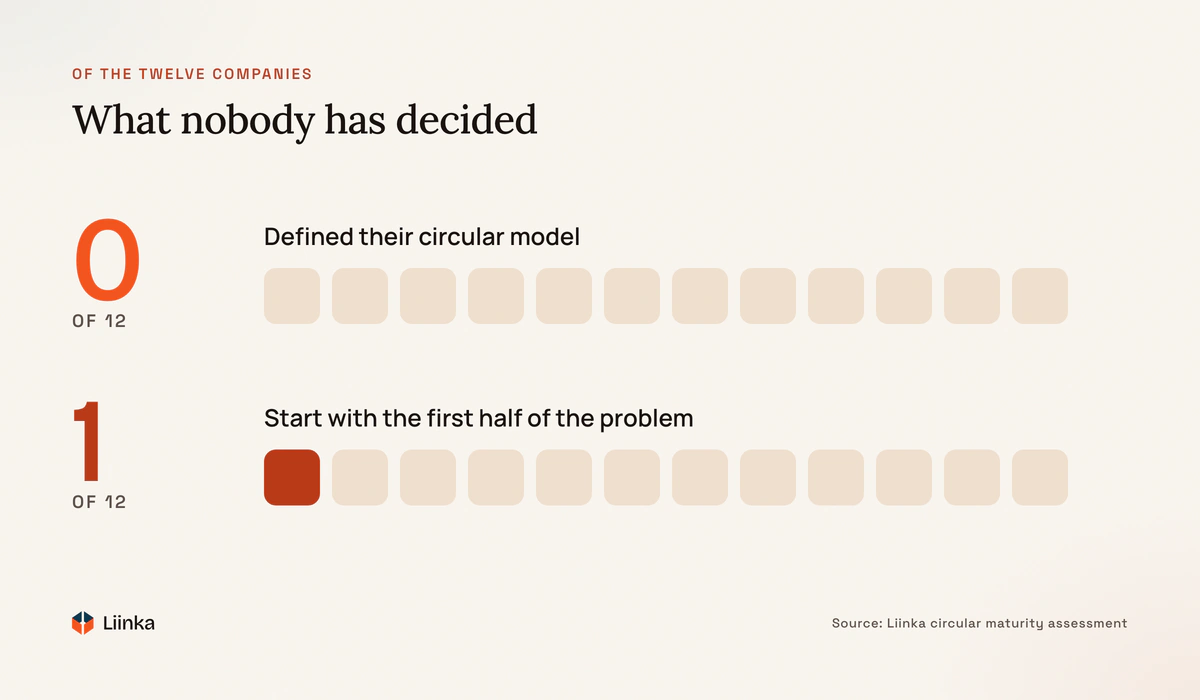
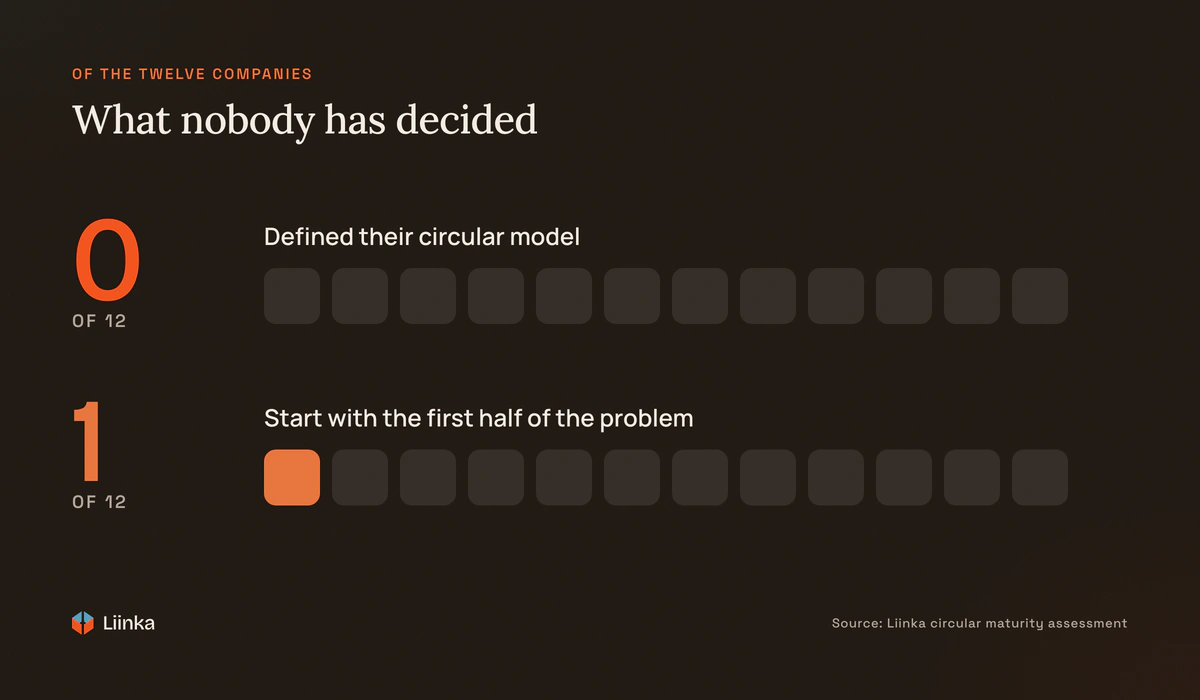
Eleven out of the twelve companies are solving the second half of a problem without focusing on the first.
Nobody has decided what kind of loop they are building
Not one company in the sample has publicly defined whether its circular operations are closed loop, open loop or hybrid.
This sounds like a documentation footnote. It is not.
That choice determines who owns the material, who captures the value, what infrastructure you need, and what the economics actually look like. Closed loop means investing in a recovery process you control. Open loop means investing in partnerships and standards you do not.
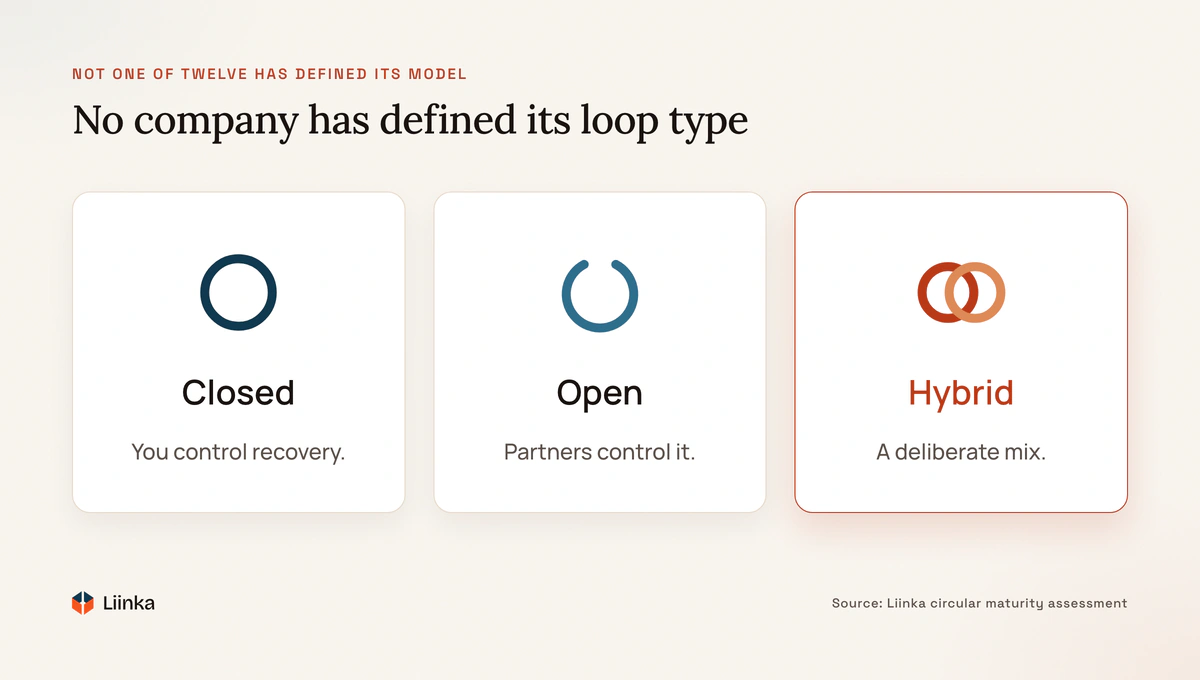
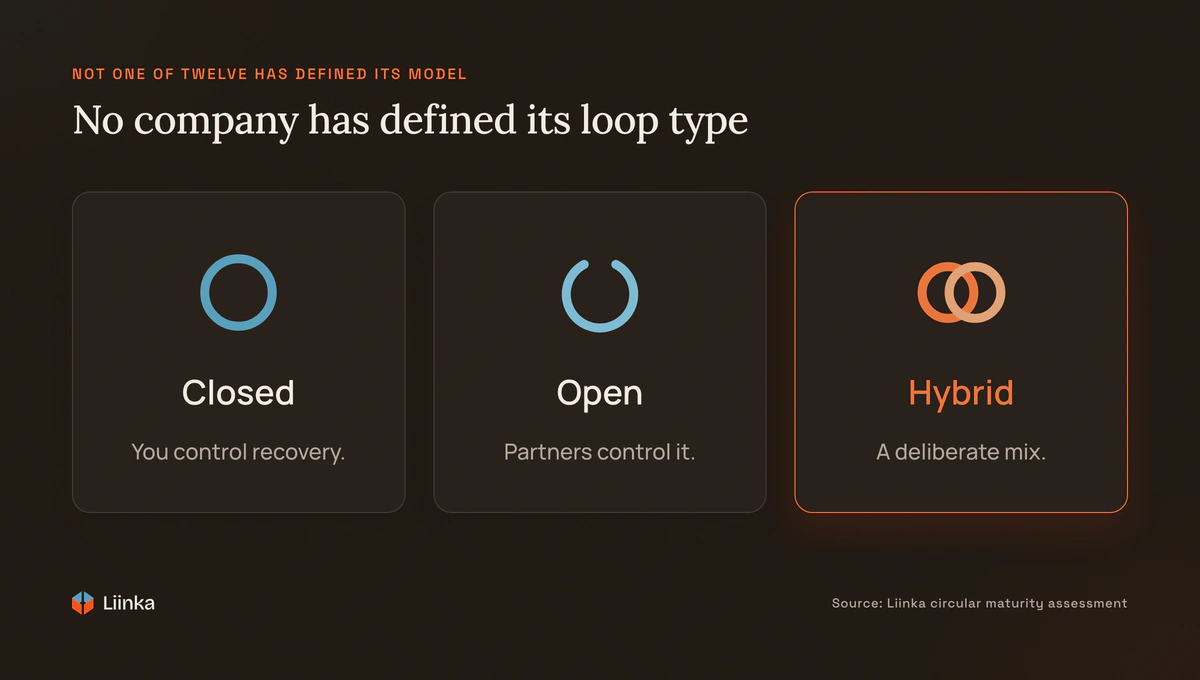
Leave it undefined and it still ends up being decided. Implicitly, project by project and by whoever happens to run each pilot. As a result, you’re left with an operating model nobody consciously chose.
Industry explains some of this. Not all of it.
The strongest performers make products whose material composition is the value proposition itself. For them, material loops and commercial strategy are one and the same, so that circularity is never an add-on.
The weakest performers reside in industries where recovery genuinely runs into regulation, contamination and safety constraints.
Some of this gap is legitimate. Circularity does not mean the same thing in every value chain, and the right benchmark is competitors facing the same material reality, not a sample average.
But the company’s sector can’t explain ignoring supplier depth or incentive alignment. These measures are available to everyone, in every industry.
What this adds up to
The loop is still open at the return stage. Everything else is downstream of this. Until returns can be forecasted, collection cannot be measured, and every other circular ambition remains theoretical.
Incentives beat intentions. Training tells people that circularity should matter. The scorecard tells them what actually matters. When those two aren’t aligned, the scorecard wins out.
Regulation makes you compliant, not circular. Tier 1 disclosure satisfy the regulator. Depth and material data are what make recovery possible.
Define your model before you scale. Closed, open or hybrid is a strategic choice with different economics. Defaulting into one is still choosing one, but in a bad way.
The encouraging read is that the hard ingredients are already available: the technology, the supplier relationships, the leadership alignment. And by-product circulation proves these companies can run material loops profitably as soon as the incentive is clear.
What is missing is organizational structure. Ownership, measurement, and a decision about the model cannot be ignored.
That is cheaper to fix than it seems.
Co-founder & CEO, Liinka