
How mature are companies in Switzerland on circular strategy and governance?
Forty-nine questions, eight dimensions, twelve large Swiss companies. The foundation is laid almost everywhere, but only two set revenue targets for their circular offerings.

Deborah de Wolff
Co-founder & CEO, Liinka5 min read
Circularity: A business opportunity, not a burden
Circularity is often presented as an environmental responsibility. We see it differently: it is one of the most underutilized sources of business value available to companies today.
The business case is clear. Circular offerings such as repair, product as a service or take back programs create new revenue streams. Keeping materials in use reduces input and waste costs. And sourcing from your own loops builds resilience against volatile prices and fragile supply chains.
This article is the first in a series exploring the different circular aspects of a company, such as strategy, supply chain, design or operations. Our ambition is to make best practices visible, so that other companies can concretely see how circularity works and find inspiration for their own journey.
Why we start with strategy and governance
Every circular transformation, from product design to reverse logistics, stands or falls with strategy and governance. Strategy defines what circularity means for the business, how it is financed and how it connects to revenue. Governance makes that decision stick through accountability, leadership and the way in which the entire organization is brought along on the journey. Without this foundation, circular initiatives remain isolated pilots, easily deprioritized and disconnected from how the company earns money.
Our framework assesses the whole system: leadership and accountability, strategic definition, financing, targets, risks and opportunities, culture and ecosystem engagement. In total, 49 questions across eight dimensions. The companies did not fill out a questionnaire: we conducted each assessment ourselves, using publicly available reporting as evidence and assigning a confidence level to every answer.
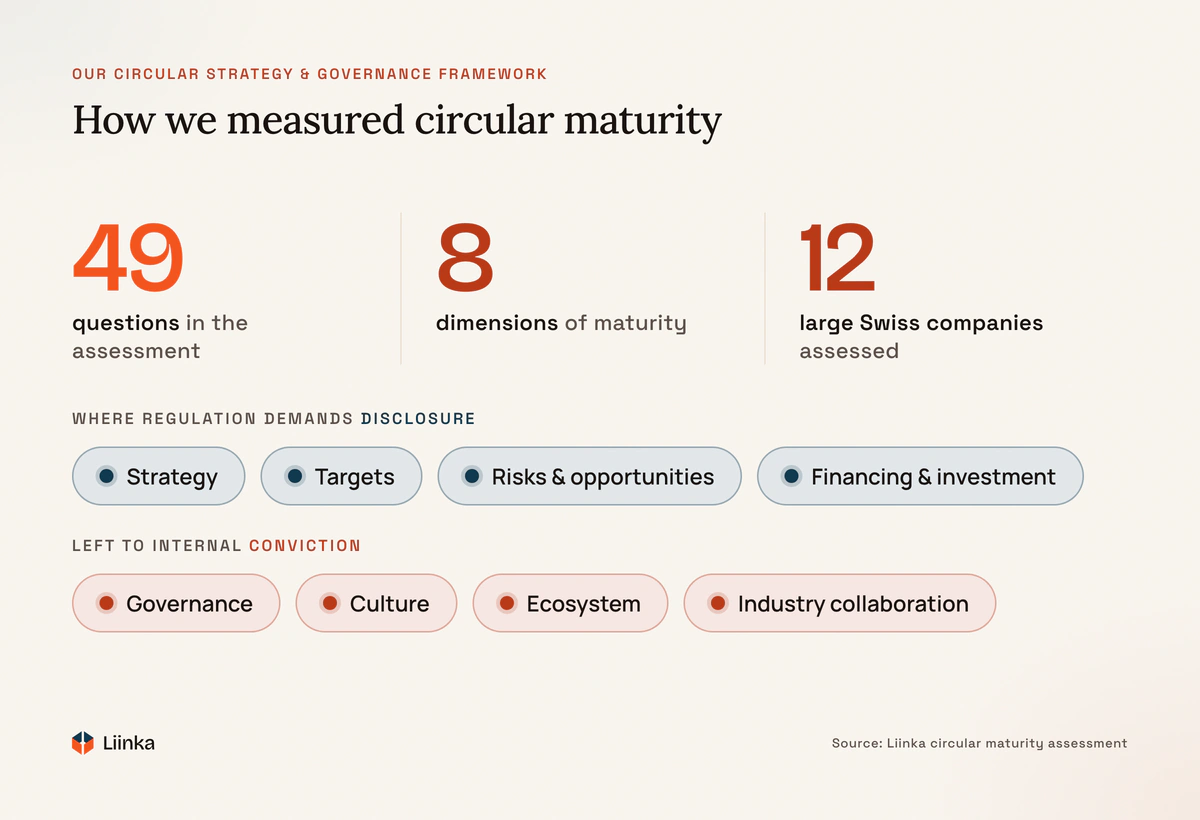
We assessed twelve large companies with a significant presence in Switzerland, covering a broad range of industries. The results are anonymized: we mention only the broad industry of each company, so you can easily see where your own organization fits into the picture.
What we found
The good news: the foundation is laid almost everywhere
Start with what works. All twelve companies understand circularity as meaning more than just recycling: end-of-life management, value chain collaboration, and stakeholder engagement are part of virtually every definition we found. Nearly all have set measurable targets for waste, eco-design, and recovery. They participate in industry coalitions, and have identified their circular risks and opportunities. The building blocks are in place across the Swiss corporate landscape, and that is a genuinely encouraging baseline.
Maturity varies enormously, and industry context explains why
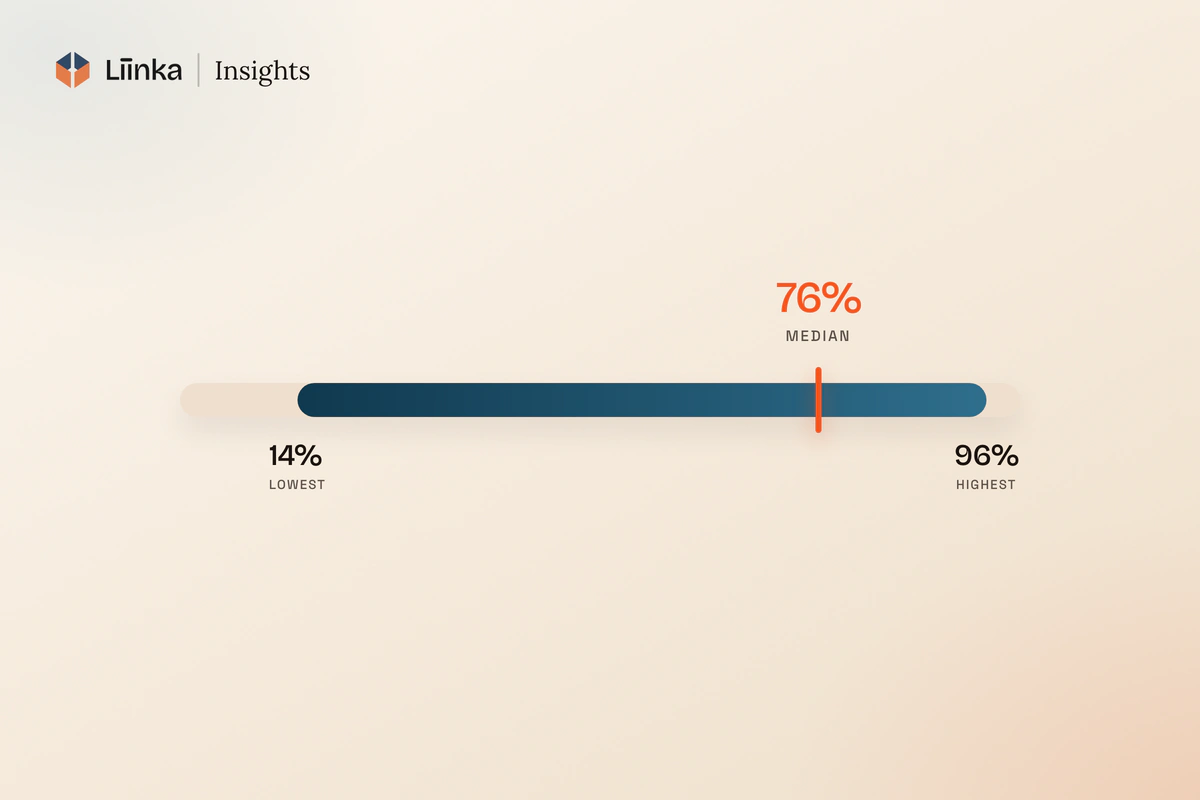
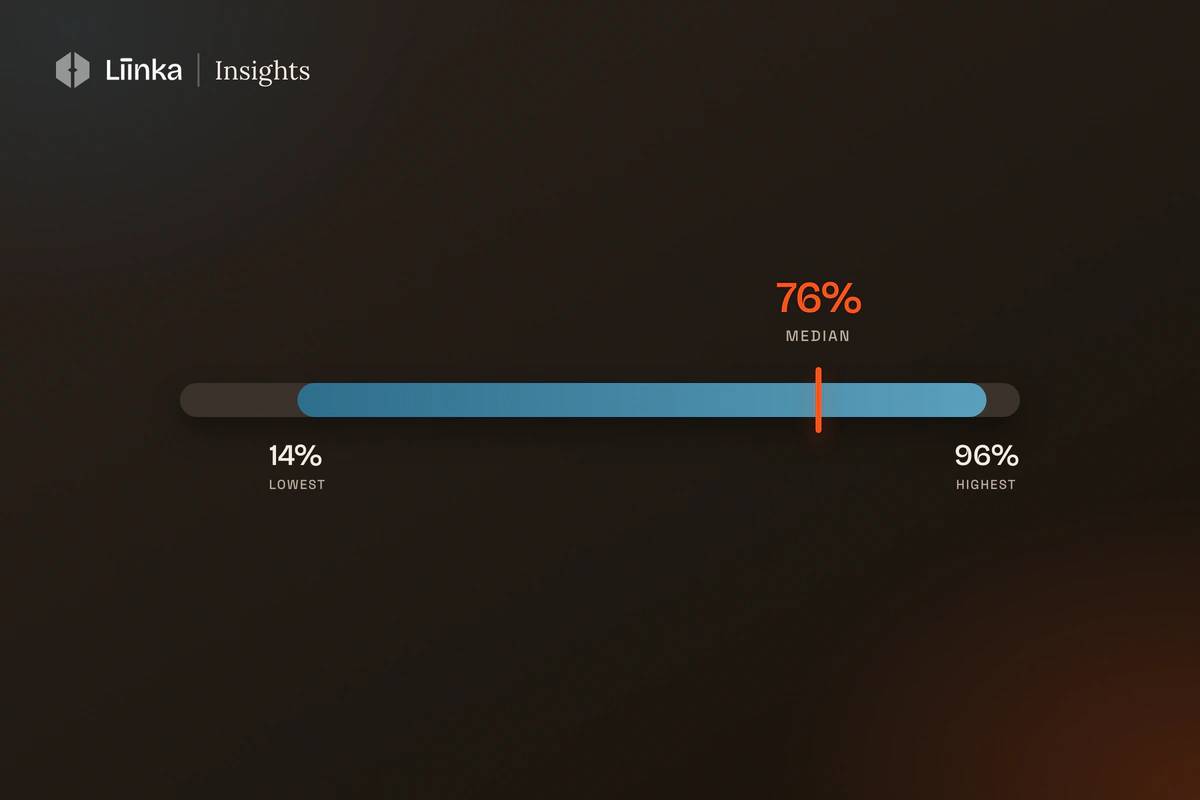
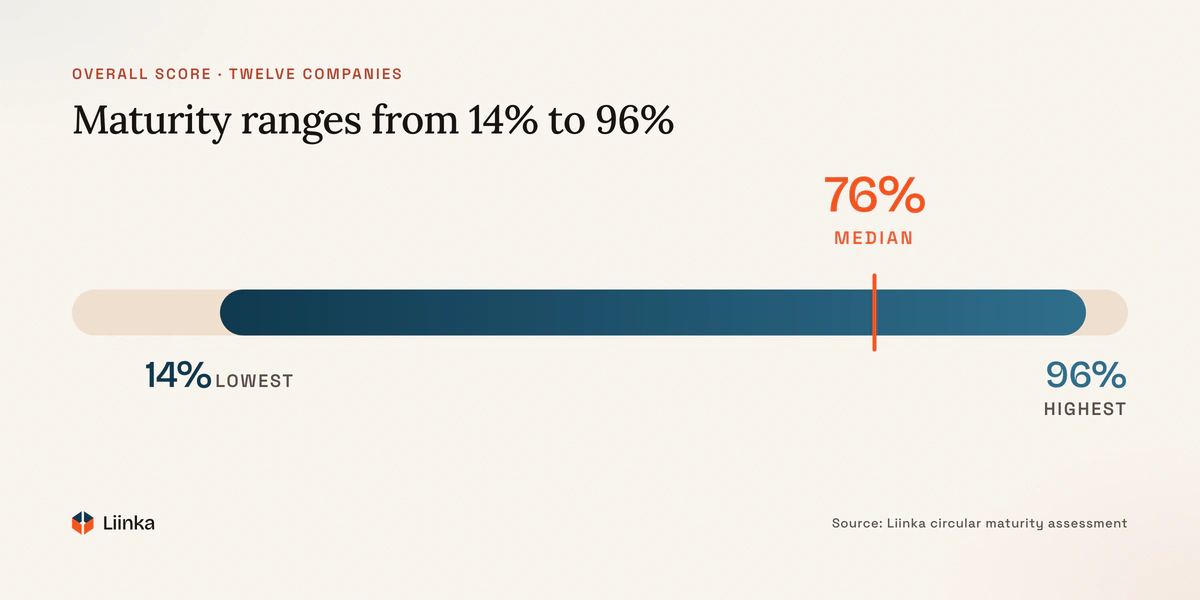
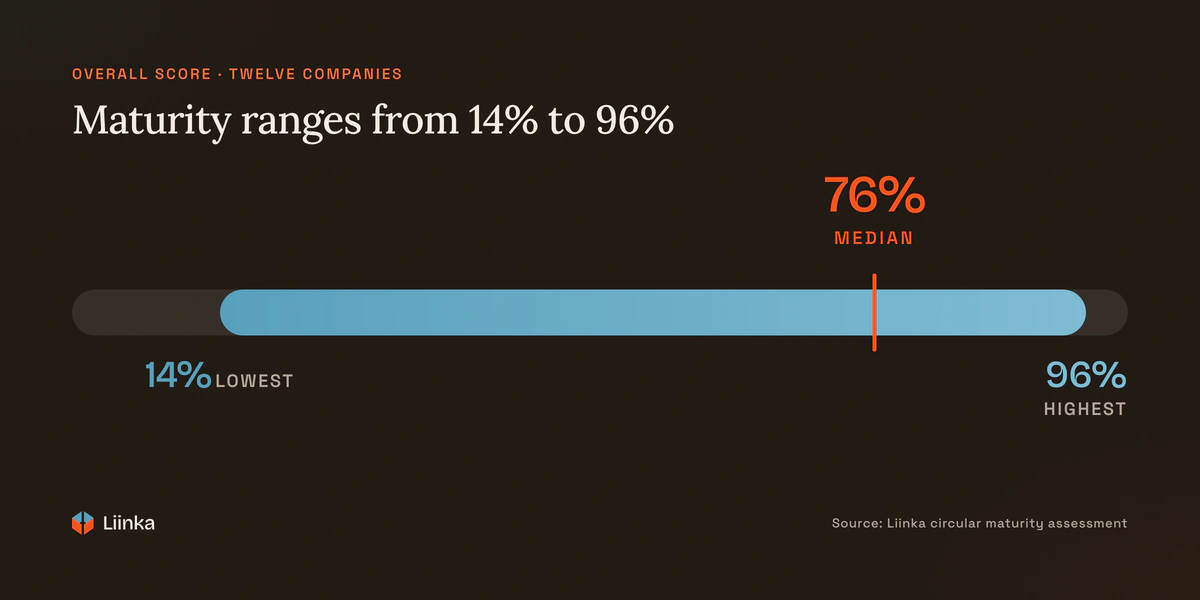
Each company received an overall score: the percentage of the framework's total points it achieved across the 49 questions, where 100% would mean full evidence of best practice in every dimension. Scores ranged from 14% to 96%, with a median value around 76%. Part of this spread is structural. Circularity does not mean the same thing in every industry, nor does it sit equally close to the core business. For packaging activities, material loops are the product itself, so circular and commercial strategy naturally merge; whereas for industrial companies, circularity means recovering products at end-of-life at an industrial scale. Companies whose business model engages with physical material loops directly tend to be further ahead.
This is why benchmarking against peers facing the same challenge matters more than chasing a universal score. Yet even within comparable industries, differences remain: what separates the leaders from the rest is whether circularity has been elevated from a reporting theme to a strategic agenda with owners, budgets, and revenue attached.
Reporting has matured faster than the organization behind it
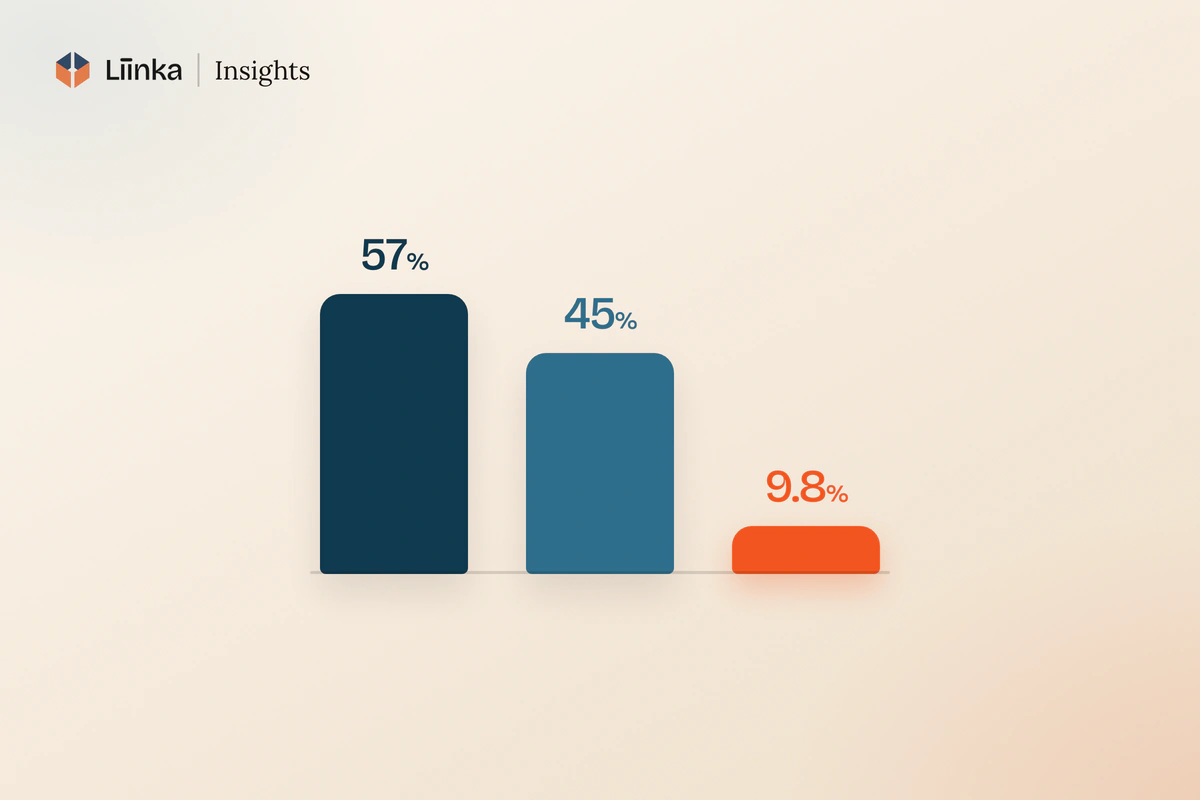
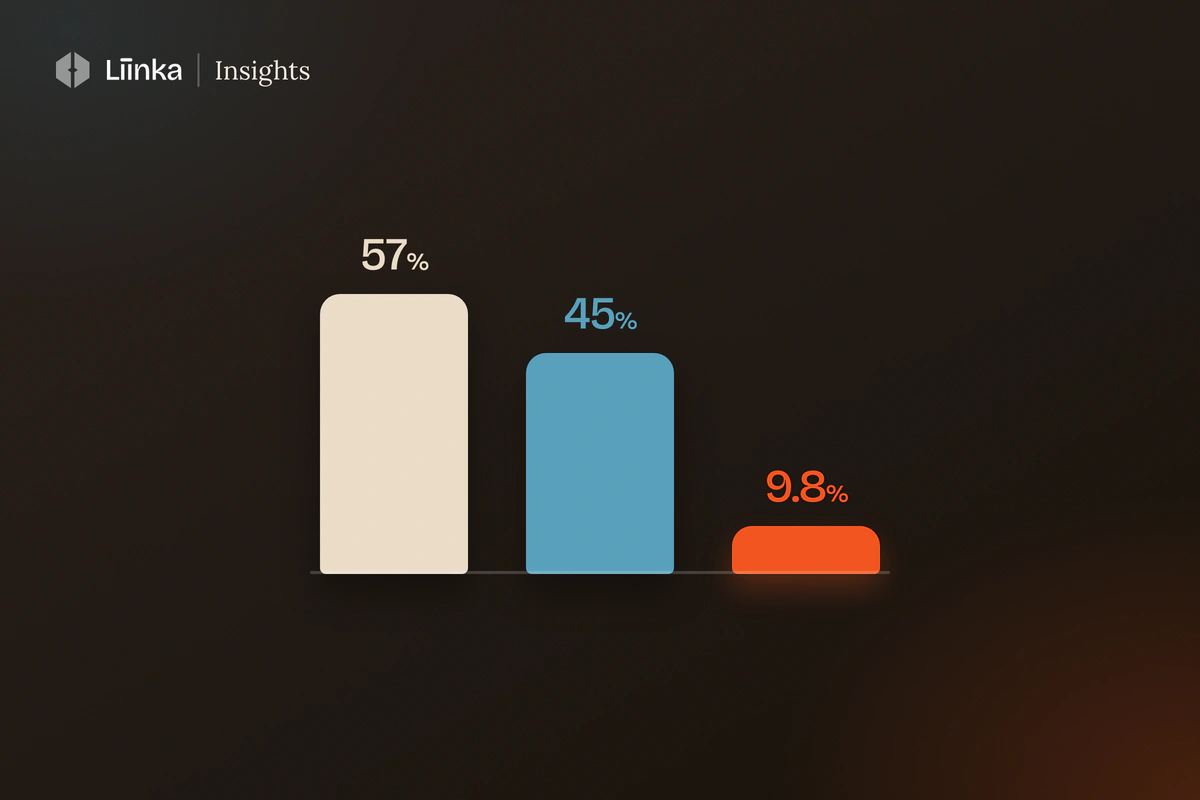
The dimensions where regulation demands disclosure are strong across the sample: 90% of possible points were attained within risks and opportunities, 81% in targets, and 72% in strategy. The dimensions that depend purely on internal conviction lag well behind: ecosystem engagement at 23%, governance at 57%, culture at 58%.
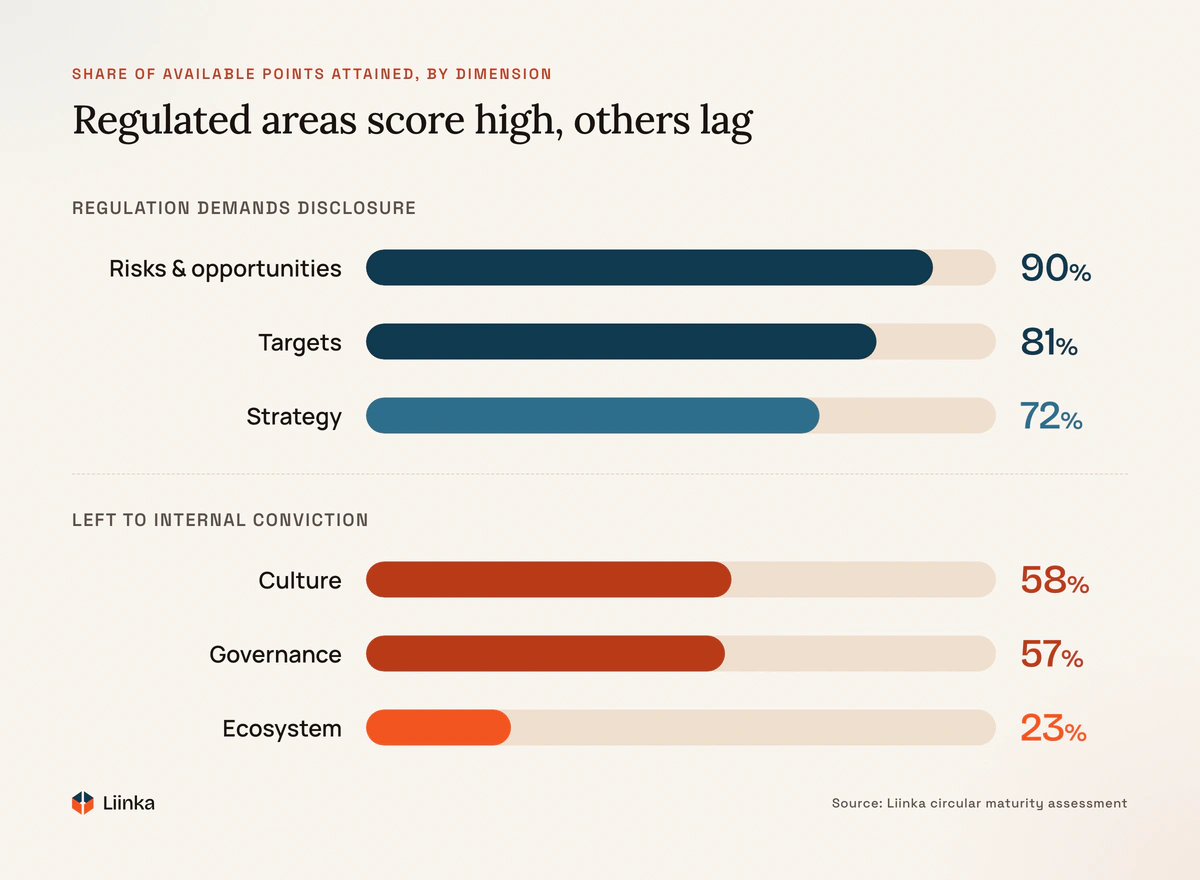
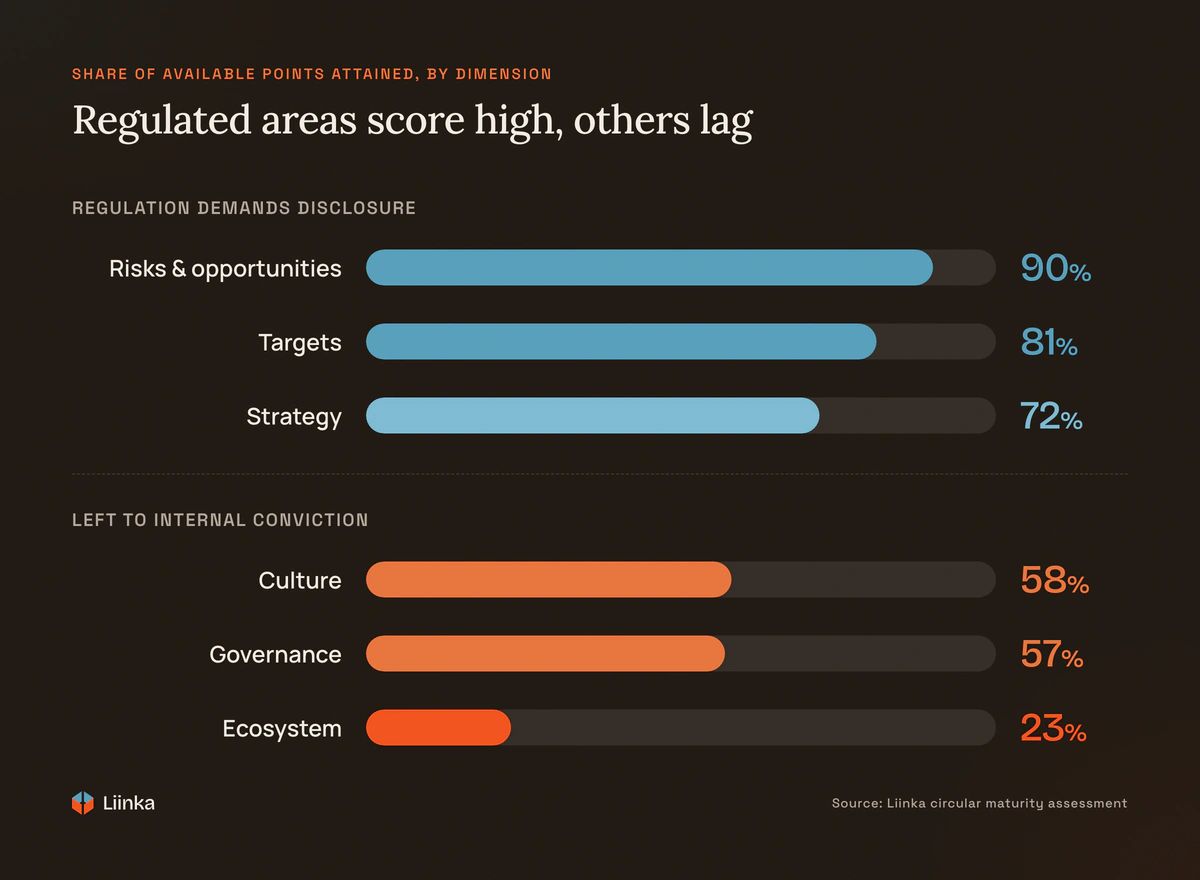
In plain terms: most companies can now describe circularity convincingly, far fewer have institutionalized it.
Regulation has lifted the floor, but it cannot build the house.
Companies that treat ESRS E5 (the EU regulation on circularity) as the finish line will keep producing excellent chapters in their annual report, while the leaders convert the same topic into gains in market position.
The revenue lens is the real dividing line
Only two of the twelve companies set targets for revenue from circular offerings, and only four even include revenue streams in how they define circularity. The rest measure circularity in tonnes, percentages, and diversion rates.
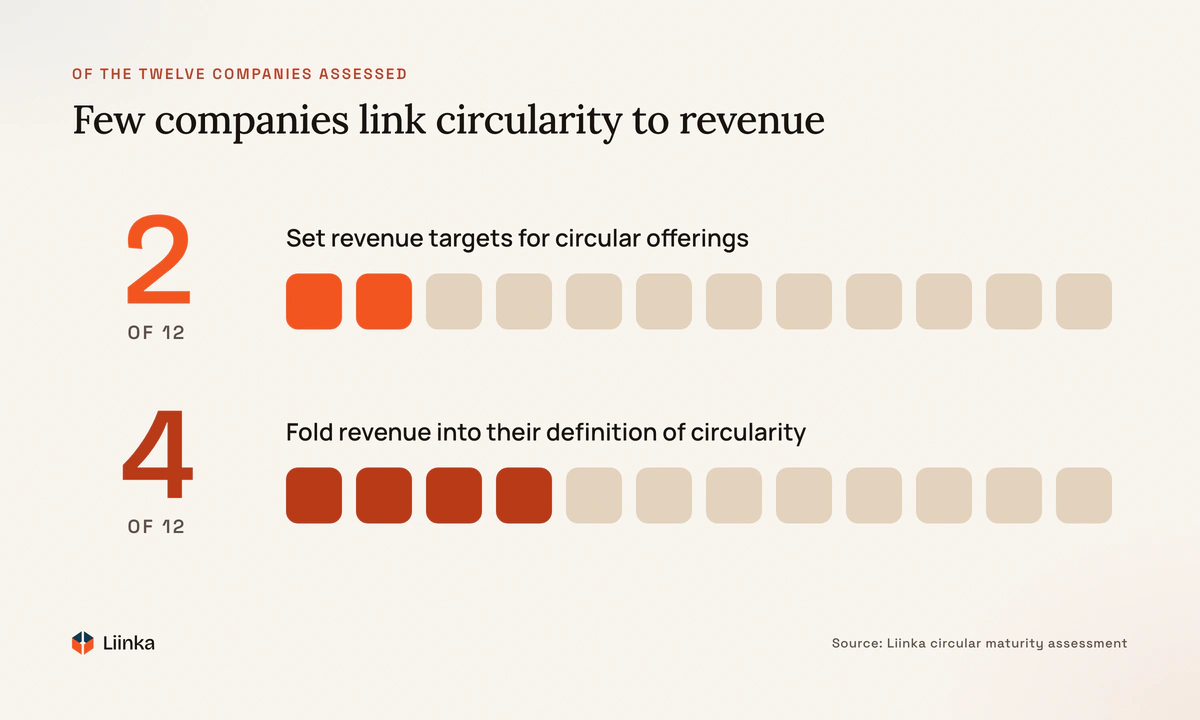
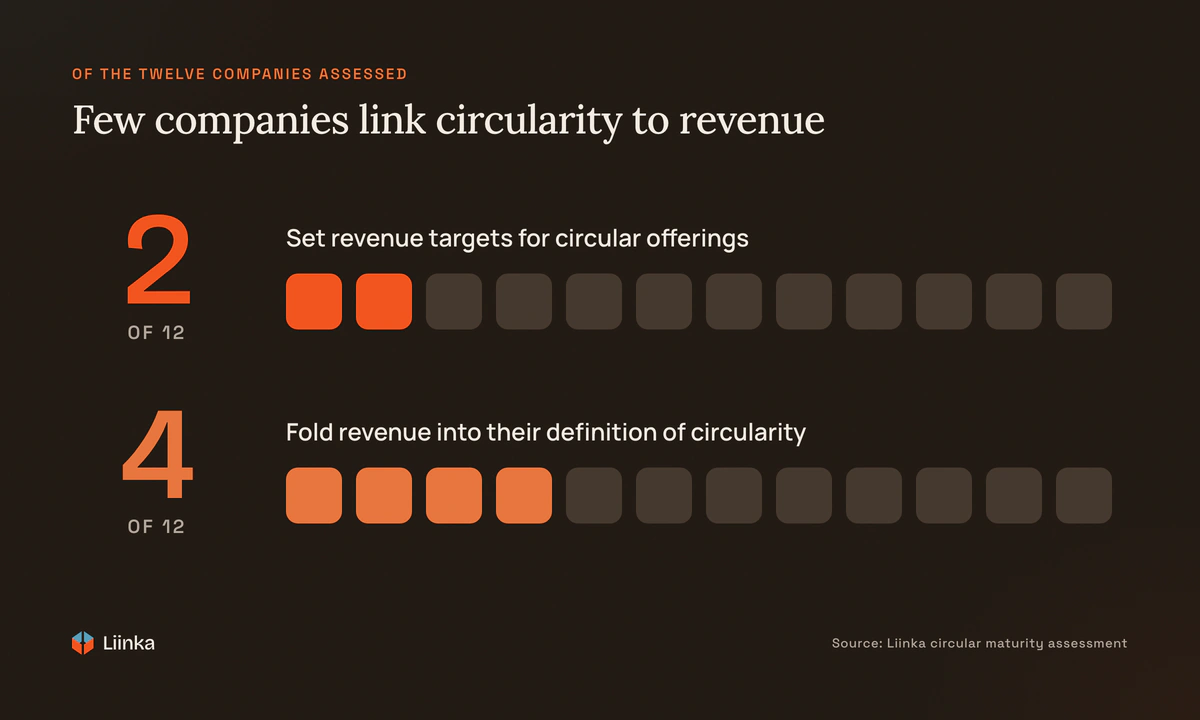
This matters more than it seems. When circularity is counted in waste metrics, it resides within the sustainability function and competes for goodwill. When it is counted in revenue, it connects to the core business strategy and drives market value.
Key learnings, and an invitation
Three takeaways from this first analysis:
The field of opportunity is wide open. The foundational work is done almost everywhere, yet the strategic layer that converts it into value, meaning distributed accountability, dedicated financing, incentives, and above all, a revenue definition of circularity, is rare. The playbook of the leaders is visible and replicable.
Regulation is a starting gun, not a strategy. Companies that stop at disclosure will be compliant; those that build on it will be competitive.
Compare yourself to the right peers. Circularity takes a different shape in every industry, so the most useful benchmark comes from companies navigating the same specific value chain and material reality as you. However, the mechanisms behind best practices apply across sectors.
This is the first article in the series. In the coming editions, we will publish further assessments and deep dives into individual aspects of circular maturity, always with the same intention: learning from what works and making it replicable.
Co-founder & CEO, Liinka